There's a moment every morning when you're not quite asleep and not quite awake — that soft, suspended second before consciousness lands fully. What you feel against your skin in that moment matters more than most people admit. The temperature of the fabric. The weight of it. Whether it feels like a hotel in Lisbon or a spa in Kyoto. That feeling is not accidental. It is, in large part, the result of a weave.
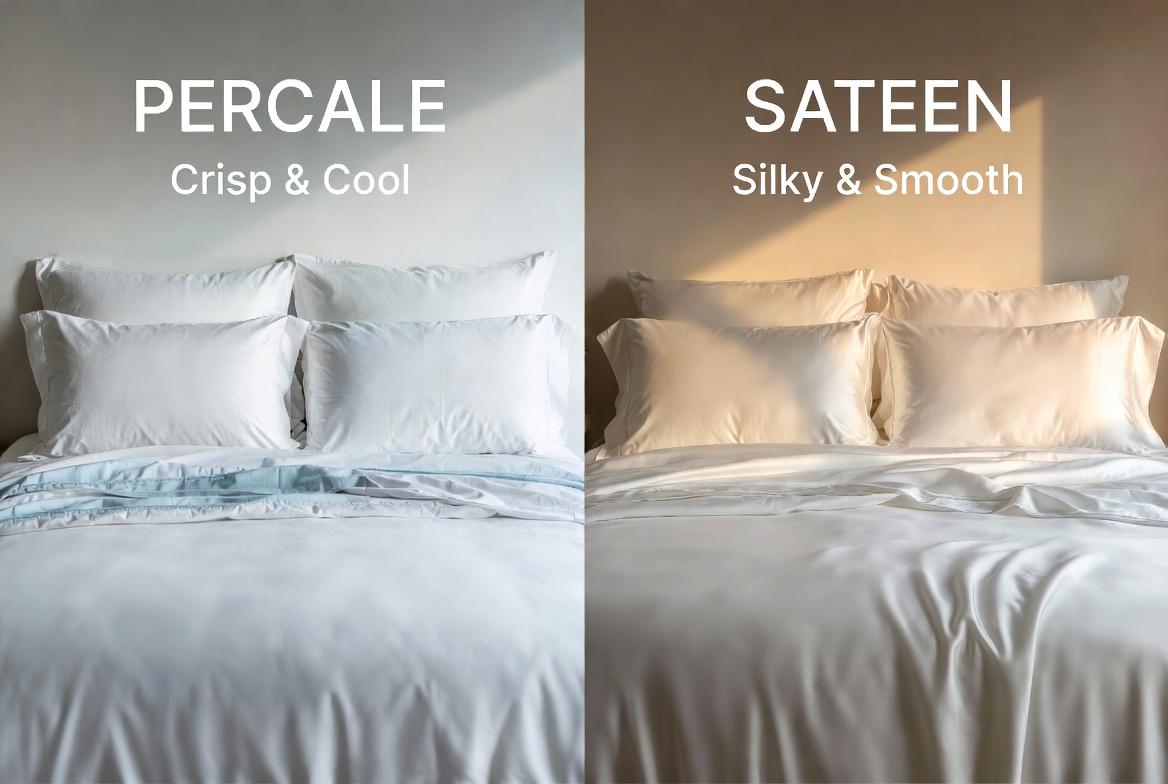
Two weaves, specifically. Percale and sateen. They are the dominant forces in the sheet world, and they could not be more different. Both are made from the same raw materials — typically cotton, sometimes bamboo or microfiber — yet the way their threads interlace produces entirely distinct sleeping experiences. One feels like a freshly pressed Oxford shirt. The other feels like a second skin made of cream.
If you've ever stood in a linen aisle, lifted two sheet sets, felt subtly confused, and put both back down — this is for you.
What Actually Makes a Weave a Weave
Before getting into the feel-good specifics, a brief mechanical interlude is necessary, because understanding weave structure is what makes every subsequent comparison actually make sense.
Fabric is made of threads going in two directions: the warp (running lengthwise on the loom) and the weft (running across). A weave pattern dictates how many times each thread passes over or under threads going the other direction before looping back. That ratio — that over-under formula — determines everything: texture, sheen, durability, breathability, how the fabric pill, how it ages.
Percale uses a one-over-one-under pattern. It's the simplest possible weave — tight, even, balanced. The result is a matte finish, a firm hand-feel, and a fabric with genuine structural integrity. Each thread locks against its neighbor. There is no give, no slide, no gloss. Just clean, flat, honest cotton.
Sateen uses a four-over-one-under pattern. Four warp threads float on top of every weft thread. This creates an uneven surface structure where threads are loosely interlocked, exposing maximum thread surface to the top side of the fabric. The result is a soft, luminous, almost liquid feel. Sateen looks polished. It catches light. It drapes.
That's it. That's the whole mechanical story. But the downstream consequences of those two patterns are enormous.
The Feel Factor: What Your Skin Actually Notices
Percale: The Clean Sheet Feeling
Percale sheets have a feel that is almost impossible to fake with anything else. It's crispness — genuine, un-synthetic crispness. They feel clean in a way that seems related to cleanliness itself. There's a slight stiffness when they're new, especially high-thread-count percale, and they soften over washes into something that feels like a beloved worn-in dress shirt: still structured, still cool, but broken-in and personal.
The texture has a very light, fine grain to it — almost like paper made soft. Touch percale and you feel the weave itself. There's friction there, just enough to feel substantial rather than slippery. For people who feel vaguely destabilized by fabrics that slide — who kick off slippery sheets in the night, who feel wrapped rather than covered — percale is the fix.
Temperature-wise, percale is cooler. The tight one-over-one weave creates tiny gaps between threads that allow air to circulate. Moisture and heat dissipate rather than build. If you wake up at 3am feeling like a baked potato, percale is almost certainly the corrective.
Sateen: The Luxury Hotel Feeling
Sateen feels expensive. There is really no more efficient way to put it. The fabric has weight and drape and that floating, frictionless surface that a certain type of sleep-obsessive person actively seeks. Running your hand across sateen is nothing like running your hand across percale — it's a different sensory register entirely. It's smooth in a way that approaches silk without the cold shock of actual silk.
The slight sheen catches light, which is why sateen sheets photograph so well and why they look spectacular made up on a bed. They fall in gentle folds rather than holding a pressed edge. They feel encompassing rather than layered.
Warmth-wise, sateen runs naturally warmer. The floating threads create a denser surface that traps heat more effectively. This is a disaster for hot sleepers and a blessing for anyone who finds themselves pulling every blanket in the house onto the bed at midnight.
Thread Count: Where the Marketing Gets Murky
Thread count — the number of threads per square inch — is how the bedding industry has trained consumers to shop, and it has created considerable confusion. The assumption is linear: higher thread count equals better sheets. That assumption is wrong, or at minimum severely incomplete.
For percale, a thread count of 200 to 400 is the sweet spot. Because the weave is tight and the threads are single-ply, a 300-thread-count percale sheet can feel extraordinary — firm, substantial, genuinely luxurious in its no-nonsense way. Push much above 400 in percale and you're either dealing with multi-ply threads (which technically inflates the count without improving quality) or a weave so tight it loses its breathability.
For sateen, thread counts tend to run higher — 300 to 600 is common — and higher counts genuinely do produce softer, more buttery fabric here, because the weave structure allows for it. The floating threads mean more material on the surface, and that material can be finer and more densely packed without sacrificing drape.
The honest advice: ignore thread count as a primary metric. Pay attention to fiber quality first — long-staple Egyptian or Supima cotton beats short-staple cotton at any thread count — and weave second. Thread count is a tiebreaker, not a headline number.
Durability and Maintenance: The Practical Truth
Percale Ages Like a Good Friend
Percale sheets are exceptionally durable. The balanced plain weave means threads bear stress evenly; no single group of threads takes the brunt of tension, friction, or wash cycles. A good percale sheet set, properly cared for, will last years longer than comparable sateen. The wrinkles — and percale does wrinkle, conspicuously — can actually be seen as proof of this durability. Wrinkles mean the fibers are intact and natural. High-quality percale also becomes noticeably softer with every wash, which is a pleasant evolutionary arc.
They're also easier to maintain. Machine wash, tumble dry low or medium, done. The wrinkles shake out reasonably in the dryer if you pull them out promptly. Ironing is optional but deeply satisfying for the aesthetically particular among us.
Sateen Ages Like a High-Maintenance Charmer
Sateen requires more care, and those floating threads are the reason why. Because warp threads sit exposed on the surface rather than being locked tightly into the weave, they're vulnerable to catching on rough surfaces, fingernails, jewelry, and the corners of phones kept under pillows. Pilling is more common. Snags are more common. The sheen, so appealing when new, can dull after repeated washing if the care instructions aren't followed.
Cold wash, gentle cycle, low heat dry — those are the sateen commandments. Skip fabric softener (it coats fibers and reduces softness over time, paradoxically). Skip high-heat drying. And keep the sateen sheets away from anything with hooks or rough edges during storage.
The Comparison Table
| Feature | Percale | Sateen |
|---|---|---|
| Weave Pattern | 1 over / 1 under | 4 over / 1 under |
| Surface Texture | Matte, slightly crisp | Smooth, silky, subtle sheen |
| Hand Feel | Firm, clean, structured | Soft, fluid, sumptuous |
| Temperature | Cool — excellent airflow | Warm — heat-retaining |
| Best For | Hot sleepers, warm climates | Cold sleepers, winter months |
| Breathability | High | Moderate |
| Sheen/Look | Matte, understated | Lustrous, polished |
| Wrinkle Resistance | Low — wrinkles easily | Moderate — wrinkles less |
| Durability | Excellent — very long lifespan | Good — requires careful handling |
| Pilling Risk | Low | Moderate to high |
| Snag Risk | Low | Moderate to high |
| Softness When New | Moderate — softens with wash | High — immediately soft |
| Ideal Thread Count | 200–400 | 300–600 |
| Best Fiber Pairing | Long-staple Egyptian or Supima cotton | Long-staple Egyptian or Supima cotton |
| Wash Care | Machine wash warm, tumble dry | Cold wash, gentle cycle, low heat |
| Price Range | Moderate to high | Moderate to high |
| Aesthetic | Hotel crisp, minimal, clean | Boutique hotel, romantic, plush |
| Who It's For | Minimalists, hot sleepers, purists | Texture lovers, cold sleepers, maximalists |
The Climate Case: Geography Should Guide Your Choice
This is an underrated factor. Where you live — and how your bedroom is heated or cooled — should absolutely influence which weave you choose.
If you're in a warm climate year-round, or if your bedroom runs warm, or if you sleep hot regardless of the season, percale is the rational choice. The one-over-one weave functions like a mesh relative to sateen — it doesn't trap heat, it allows evaporation, it keeps the sleep environment stable.
If you're in a cold climate, or if your bedroom skews drafty, or if you're a person who genuinely cannot get warm at night no matter how many blankets you pile on — sateen will make your sleeping life dramatically better. The dense, floating-thread surface creates a subtle insulating effect. You will feel held rather than covered.
Many dedicated sheet enthusiasts keep both: percale for spring through fall, sateen for winter. It sounds fussy until you try it, and then it sounds completely reasonable.
Cotton Varieties: The Material Beneath the Weave
The weave is structural, but the fiber is where character lives. Both percale and sateen are typically made from cotton, but not all cotton is the same.
Egyptian cotton grows in the Nile Delta and produces extra-long-staple fibers — meaning each individual cotton fiber is longer than standard. Longer fibers mean fewer fiber ends per inch of thread, which means a smoother, stronger, less prone-to-pilling fabric. Egyptian cotton percale is arguably the pinnacle of the crisp-and-cool category. Egyptian cotton sateen is the gold standard for silky luxury.
Supima cotton is the American equivalent of Egyptian — also extra-long-staple, grown in California and other southwestern states, and subject to a trademarked certification that prevents labeling fraud. Supima percale tends to have a very slightly softer hand than its Egyptian counterpart while maintaining that clean structure.
Pima cotton (without the Supima certification) is also long-staple but grown more broadly — quality varies more significantly, so the brand and source matter more here.
Standard cotton produces a shorter staple, which means more fiber ends, more surface fuzz, quicker pilling, and a less refined feel over time. It works, but it shows its limitations after a year of washes.
The advice: always prioritize long-staple cotton — Egyptian or Supima — regardless of whether you're buying percale or sateen. It's the single quality indicator that affects the experience more than any other.
The Aesthetic Argument: Style in the Bedroom
Sheets are furniture. They cover the largest visible surface in most bedrooms — the bed — and they do it for a third of every day. The visual and tactile personality of your bedding shapes the entire character of the room.
Percale bedding creates a certain look: crisp, clean, tailored. Think white or pale linen tones, visible texture, beds that look made even when they're loosely pulled up. It's the aesthetic of Nordic hotel rooms and certain Paris apartments — intentionally unfussy, quietly rigorous. Percale is what people who genuinely do not care about appearing to have good taste actually have good taste in.
Sateen creates a different atmosphere: softer, richer, more deliberately comfortable. The sheen is visible even in photographs. Colors appear more saturated — a navy sateen sheet is a more dramatic navy than the same cotton in percale. Deep jewel tones, dusty roses, warm creams — they all look magnificent in sateen. It's the bedding choice of people who want their bedroom to feel like a destination.
Neither is objectively superior aesthetically. They express different values, different relationships to comfort, different visions of what rest should look like.
Who Should Buy Percale Right Now
Buy percale if: you're a hot sleeper, you live somewhere warm, you love the feeling of a crisp-sheeted hotel bed, you appreciate fabrics that age gracefully and last years, you don't mind (or genuinely enjoy) the process of ironing or at least don't mind visible wrinkles, you prefer a matte aesthetic, or you're just starting to take sheets seriously and want a forgiving, durable foundation.
The best percale sheets on the market today come from brands that use certified Egyptian or Supima cotton and maintain thread counts between 270 and 400. Anything marketed as percale under 200 thread count tends to feel thin and papery rather than crisp and clean.
Who Should Buy Sateen Right Now
Buy sateen if: you sleep cold, you live somewhere chilly, you want your bed to feel unambiguously luxurious, you love the way high-end sheets feel in hotel suites, you're willing to follow careful washing instructions to maintain that feel, you want deeper colors and a more polished bedroom aesthetic, or you have a partner who values warmth and softness above all else.
The best sateen sheets use long-staple cotton, have thread counts above 350, and come with specific cold-wash care instructions. If the label says "machine wash hot" — that's not a premium sateen. Walk away.
The Case for Owning Both
Serious sleepers — and the category is larger and more earnest than it might seem — eventually end up with sets of both. The rationale is simple: your thermal needs in July are not your thermal needs in January, and the right tool for the job is different. Rotating between percale in summer and sateen in winter is not eccentric. It's the logical conclusion of caring about how you sleep.
If you're going to try this, start with percale. It's more versatile across temperatures, it's more durable, and it establishes a baseline against which the sateen softness is then genuinely revelatory when you rotate in. The contrast is part of the pleasure.
A Final Word on What Sleep Deserves
The amount of time humans spend in bed — roughly a third of their lives, if the eight-hour ideal is met — is so large it barely registers as a number. It's abstract. But the cumulative texture of those hours, the quality of that rest, the sensory environment in which the body recovers and the brain consolidates memory and the nervous system decompresses from whatever the day brought — that is not abstract. That is the actual substance of a life.
A sheet is a small thing. It costs what a dinner out costs, or what a pair of good shoes costs. But it touches your skin every single night. It is present at your most unguarded. What it feels like matters, and the decision between percale and sateen — crisp and cool versus silky and smooth — is a genuine decision about how you want those hours to feel.
Choose accordingly. Sleep is not downtime. It is the main event.
Still not sure which way to go? Start with percale — it forgives more, lasts longer, and delivers the clean-slate sleep experience that most people discover they've been missing. Then, one winter, pick up a sateen set. By February, you'll understand both sides of the argument completely.