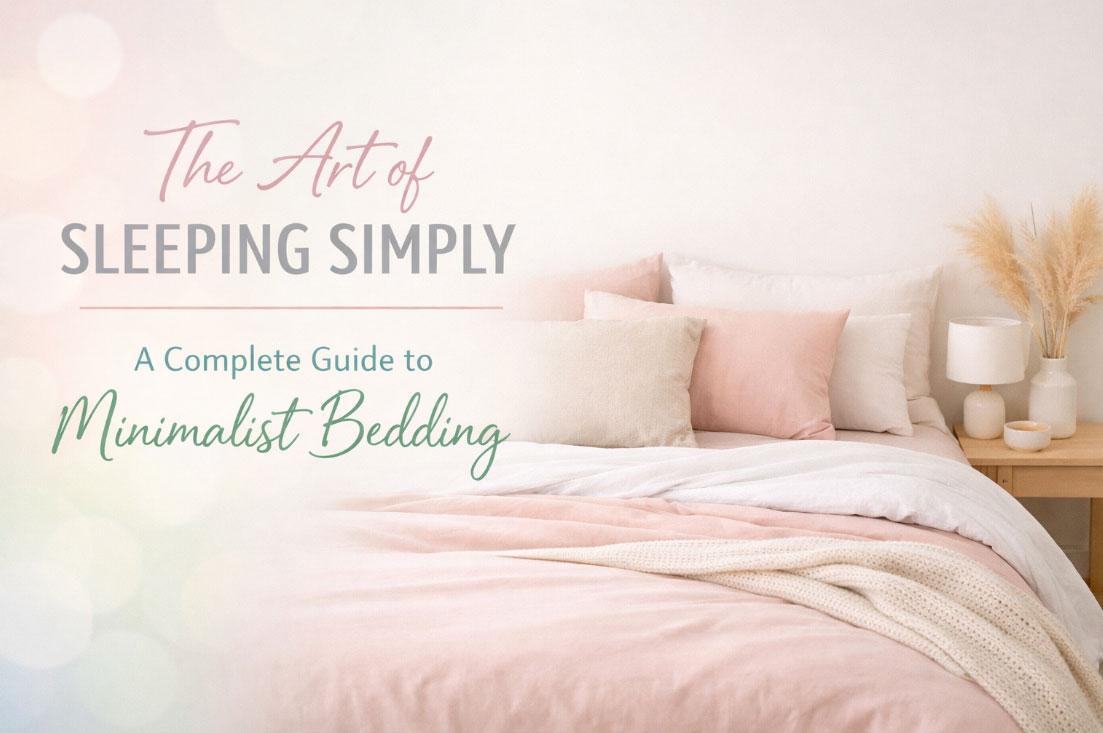
There is a particular kind of peace that comes from walking into a bedroom stripped of everything unnecessary. No decorative pillows stacked three rows deep. No throws draped at calculated angles. No busy prints competing for your attention the moment you open your eyes. Just a bed — well-made, composed, and quietly confident in its own restraint. This is what minimalist bedding delivers, and once you've slept in that kind of calm, it's very difficult to go back.
Minimalism in bedding isn't about deprivation. It's about precision. It's about choosing fewer things that matter more, and letting quality speak louder than quantity. In a world where bedroom aesthetics have veered toward the theatrical — headboard galleries, layered duvet sculptures, color palettes so intricate they require mood boards — there is something radical about the simple bed. The white sheet. The single pillow. The linen that wrinkles in a way that looks intentional.
This guide is for anyone who has stared at their unmade bed and felt, in that honest early-morning light, that they'd like things to be different. Simpler. Better. More like rest and less like performance.
Why Minimalist Bedding Is Worth Taking Seriously
The bedroom has become the most photographed room in most homes. What started as a private sanctuary has turned, for many people, into a stage set — carefully arranged for an audience that may or may not ever see it. The problem with performing rest is that you stop actually resting.
Minimalist bedding is a conscious rejection of that tendency. When your bed doesn't demand anything from you — no fluffing, no arranging, no hunting for the decorative pillow that goes on top of the other decorative pillow — it becomes what a bed was always supposed to be: a place you can fall into at the end of the day without thinking.
There's also a sensory argument. Fewer layers, fewer textures, and fewer colors mean a sleeping environment that doesn't stimulate the brain unnecessarily. Sleep researchers have noted for years that visual clutter in the bedroom can contribute to difficulty falling asleep and reduced sleep quality. A minimalist bed is, in practical terms, a healthier bed.
And then there's the matter of maintenance. A bed with six decorative pillows, a Euro sham, a bolster, two throws, and a duvet that needs to be re-stuffed into its cover every morning is a small daily ordeal. A bed with two sleeping pillows and a well-made duvet takes ninety seconds to sort out. That ninety seconds, multiplied across a year, starts to feel significant.
The Foundation — Choosing the Right Sheet Set
Everything begins with the sheet. In minimalist bedding, the sheet isn't background noise — it is the main event. When you're not relying on pattern and decoration to carry the visual weight, the quality and character of the fabric become everything.
Linen — The Gold Standard of Minimalism
Linen has had a prolonged cultural moment, and it deserves every bit of it. There is no other fabric that ages as well, wears as honestly, or looks as deliberately imperfect as linen. The natural slub texture, the way it wrinkles without apology, the slightly rough-and-soft paradox of well-broken-in linen against skin — these qualities are why linen has become the fabric of choice for anyone serious about a minimalist bedroom.
European flax linen — grown primarily in France, Belgium, and the Netherlands — is the benchmark. French linen in particular, from the Normandy and Brittany regions, is regarded as among the finest in the world. The fibers are long and strong, which means the fabric softens with washing rather than deteriorating. A quality linen sheet set will outlast almost anything else you own for the bedroom.
For color, start with natural undyed linen — the warm, slightly sandy off-white that is the fabric's true color. It photographs beautifully in natural light, it pairs with virtually every wall color, and it improves visually with age. From there, stone gray and dusty white are the two most versatile minimalist options. Both read as neutral without being cold.
Percale Cotton — The Crisp Alternative
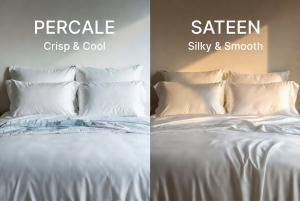
If linen's rumpled character doesn't appeal to you, percale cotton is the minimalist's other great ally. Percale is woven in a one-over-one-under pattern that produces a crisp, cool, matte finish — it's the fabric that makes hotel beds feel so composed. A high-thread-count percale in a long-staple cotton (Egyptian or Pima) will feel almost architectural in its precision, with none of the soft sloppiness of sateen weaves.
Percale cotton suits people who make their beds with military tidiness and who find a perfectly tucked sheet corner aesthetically satisfying in a way that transcends practicality. It suits warm sleepers too — percale is noticeably cooler than sateen, and significantly cooler than most synthetic fabrics.
Thread Count Is Mostly a Marketing Story
One thing worth knowing: thread count, as a quality indicator, is largely a fiction created by the marketing departments of mid-tier bedding brands. What matters is the fiber itself — its length, its origin, and the skill of the weave — far more than how many threads were crammed into an inch. A 300-thread-count long-staple cotton percale will feel better, last longer, and look better than a 600-thread-count short-staple cotton with a sateen weave, regardless of what the packaging implies.
The Duvet — One Layer, Done Right
In minimalist bedding, the duvet does the heavy lifting. There are no backup blankets, no decorative throws folded at the foot of the bed, no secondary coverlets. The duvet is it. Which means it needs to be genuinely excellent.
Fill Material — Down vs. Alternative
Ethically sourced European white goose down remains the finest insulating material available for duvets. It's light, it compresses and then expands back to full loft, and it regulates temperature better than any synthetic fill. A quality goose down duvet — filled with a fill power of 700 or above — will be noticeably loftier and lighter than cheaper alternatives, which matters both for sleep quality and for aesthetics. A high-loft duvet sitting inside a clean white or linen cover has an almost architectural presence in a room.
For those who prefer to avoid animal products, there have been genuine advances in synthetic fill quality in recent years. Microfiber and gel-fiber fills now approximate the feel of down better than they ever have. They're also easier to wash at home, which matters for the kind of low-maintenance sleeping environment that minimalism values.
Duvet Covers — Where Restraint Pays Off
If you can afford to invest in one item in your minimalist bedding setup, make it the duvet cover. This is the piece that is most visible, most frequently touched, and most defining of the bed's overall character. A cheap duvet cover with pilling and a dull finish will undermine everything else you've done. A genuinely beautiful one — in a washed linen or a high-quality cotton muslin — will elevate the entire room.
The best minimalist duvet covers share certain characteristics: they have a matte rather than shiny finish (sateen covers tend to catch light in ways that read as cheap at scale), they have a generous fill opening that makes duvet insertion less of a physical ordeal, and they have subtle rather than decorative closures — button closures in a fabric-covered or mother-of-pearl version over plastic snaps every time.
Stick to a narrow color palette: white, off-white, natural linen, stone, dove gray, or warm sand. These colors form the backbone of minimalist bedding and they work with each other, making future additions or changes seamless.
Pillows — Two Is Enough
Here is where minimalist bedding and mainstream bedding culture diverge most dramatically. The standard contemporary bed, as styled in most shelter magazines and home goods catalogs, involves somewhere between four and ten pillows. Two sleeping pillows, two Euro shams, two standard shams, a bolster, and perhaps a couple of accent pillows arranged at slightly different heights for visual depth.
The minimalist bed has two pillows. That's it.
This is not austerity for its own sake. Two pillows is what most people actually sleep on. The rest is theater. And when you strip back to just the sleeping pillows, you free up time, mental energy (nothing to arrange, nothing to take off the bed and put somewhere every night), and you allow the duvet and sheets to be the visual subject rather than the decorative accessories.
Sleeping Pillow Quality
With only two pillows in play, the quality of those two pillows matters considerably. A flat, lumpy pillow looks bad and affects sleep quality — and in a minimalist bed, there's nowhere to hide it behind a sham. Invest in proper sleeping pillows.
Fill preference is personal — down, down alternative, latex, and memory foam all have their advocates — but for minimalist aesthetics, a down or down alternative pillow in a high-quality cotton or linen cover will achieve the right visual weight and softness. Latex and memory foam pillows, while excellent for support, have a stiffer profile that can look less organic on a minimalist bed.
Pillowcase Choices
Pillowcases in a minimalist setup should match the duvet cover, or work within the same narrow color palette. Mixing textures intentionally — a linen pillowcase with a cotton duvet cover, for example — can add quiet visual interest without adding visual noise. The key word is quiet. The texture difference should be something you notice on close inspection, not something that announces itself from across the room.
Color — The Discipline of Neutral
Color is where minimalist bedding finds its clearest expression, and also where it demands the most discipline. The temptation, when building a minimalist palette, is to introduce "just one" accent color — a navy pillow, a terracotta throw. The restraint required to resist that temptation is what separates a genuinely minimalist bed from a bed that is simply less cluttered.
The Classic Monochromatic Approach
The purest minimalist bedding palette works within a single color family — usually warm whites, natural linens, or soft grays — and varies only in texture and weight. A bed made up of ivory linen, natural cotton, and oyster white has more visual interest than most people expect, because the eye picks up on subtle tonal variations and fabric differences that a busy pattern would completely obscure.
This approach rewards quality fibers. When pattern and decoration are removed, the material itself has to carry the visual interest, and it can — provided you're working with fabrics that have inherent character. A natural linen duvet cover has a slight grain and variation in color that a uniform printed cotton can never achieve.
Moving Beyond White Without Adding Noise
Not everyone lives in a space that suits all-white bedding, and not everyone wants it. For rooms with warm wood tones, deep wall colors, or significant natural light, a warmer neutral palette often works better. Earthy off-whites, warm grays, oatmeal tones, and the full range of sand-to-stone shades can all anchor a minimalist bed without reading as colorless.
What to avoid: any color that creates contrast with itself. The moment a pillow is noticeably darker or lighter than the duvet in a way that reads as decorative, you've left minimalism and entered "layered neutral" territory — which is perfectly valid aesthetically, but is a different thing.
Texture — The Minimalist's Secret Weapon
When color and pattern are reduced, texture becomes the primary source of visual and tactile interest. This is one of the great pleasures of minimalist bedding: because there is less to look at, you start to really see what's there. The difference between a rough-woven linen and a smooth cotton percale becomes interesting. The weight of a heavyweight duvet versus a lightweight summer one becomes a consideration.
Mixing Fabrics Thoughtfully
The most interesting minimalist beds mix fabric textures within a consistent color palette. Washed linen pillowcases against a cotton percale duvet cover. A heavyweight linen throw (when a throw is included at all) folded precisely at the foot of the bed against cotton sheets. The juxtaposition should be felt more than seen.
One rule: no more than three distinct textures on a bed at once. Beyond that, even within a neutral palette, the bed starts to feel as though it was assembled rather than composed.
The Waffle Weave Option
Waffle weave cotton has become a significant presence in minimalist bedding in recent years, and for good reason. The textured grid pattern adds dimensional interest without approaching anything like a print or motif. In white or off-white, a waffle weave throw or duvet cover looks deliberately simple while having more visual presence than a flat fabric.
The Throw — When One Is Warranted
The question of whether to include a throw is the great debate within minimalist bedding circles. On one side: the throw is unnecessary, the duvet is sufficient, and adding a folded throw at the foot of the bed is a decorative gesture incompatible with genuine minimalism. On the other: a single throw, used correctly, adds practical value (warmth when sitting on the bed before sleep, a lighter cover during warmer months) and a moment of textural contrast that grounds the bed visually without overwhelming it.
Both positions have merit. If you include a throw, these are the non-negotiable requirements: one throw only, folded flat and precisely (not casually draped), in a fabric that complements rather than contrasts with the bed, and in a color that sits comfortably within your established palette. An oversized merino wool throw in a natural oatmeal tone, folded in thirds at the foot of a linen bed, is one of the few additions that can strengthen rather than dilute a minimalist aesthetic.
Practical Minimalism — Maintenance and Longevity
There is a practical argument for minimalist bedding that often goes unstated: it's simply much easier to maintain at a high level over time. A bed that requires twenty minutes to strip and make each week for washing is a bed that probably doesn't get washed as often as it should. A bed that takes five minutes is a bed that gets properly cleaned.
Washing and Care
Linen improves with washing. This is not a consolation for difficult care requirements — it's genuinely true. Linen washed at 60°C (140°F) repeatedly over several years develops a softness and drape that new linen simply doesn't have. Cotton percale, washed more gently and dried at a lower temperature, will maintain its crisp character without degrading. Neither requires ironing — linen's natural wrinkles are part of its appeal, and percale's tight weave resists creasing enough that air-dried bedding rarely needs pressing.
Seasonal Adjustments Without Accumulation
One of the challenges of minimalist bedding is managing seasonal comfort without acquiring more things. The solution is to own two duvet inserts — one heavier (around 10.5–13.5 tog for European ratings) and one lighter (4.5–7 tog) — and swap them with the seasons. The cover stays the same; only the fill changes. This is the kind of systematic approach that keeps a minimalist bedroom genuinely minimal rather than minimally decorated but practically crammed.
Sourcing Minimalist Bedding — What to Look For
The market for minimalist bedding has expanded enormously over the last decade, which is good news for quality and choice, but also means there is a significant amount of greenwashing and aesthetic imitation to navigate.
Brands worth attention typically share certain characteristics: they offer a limited color range rather than an extensive palette (a sign that they've curated rather than mass-produced), they're transparent about fiber origins and supply chains, they use natural dyes or undyed fabrics, and their design language is consistent rather than trend-driven. Stone Garnet, Cultiver, Brooklinen's linen range, and Parachute are among the brands that have earned genuine credibility in this space — but the field is wider than it's ever been, and genuinely excellent independent linen producers, particularly in Lithuania, Portugal, and France, are worth seeking out.
What to be wary of: brands that use "minimalist" as a marketing word while offering products with subtle patterns, decorative stitching, or color ranges that include twelve variations of "dusty rose." Real minimalist bedding is confident enough in its material quality to sell without visual tricks.
Small Bedrooms, Big Impact
One of minimalist bedding's most compelling practical arguments is what it does for small spaces. A double or queen bed in a modest room, made up with busy bedding, can feel as though the bedding is consuming the space. The same bed, made up with clean linen or cotton in a neutral tone, recedes visually — it takes up the same physical space, but it claims less of the room's visual attention, making the space feel larger and more composed.
This is particularly relevant for studio apartments, where the bed is also the sofa, the reading chair, and possibly the workspace. A well-made minimalist bed in that context reads as deliberate and designed. It's the difference between a space that says "this is where I sleep" and one that says "this is a space I've thought about."
The Bedroom as Sanctuary — A Final Argument
There is a broader case to be made for minimalist bedding that goes beyond aesthetics, beyond practicality, and beyond the specifics of linen versus cotton. It is the case for reclaiming the bedroom as a place that is genuinely yours — not curated for an audience, not designed to look impressive, not assembled from a trend report.
The minimalist bed, at its best, is deeply personal. It reflects an understanding of what you actually need rather than what you're supposed to want. It says: I have thought about what it takes for me to sleep well, to wake up gently, to move through this room without friction, and I have arranged things accordingly.
That is a more radical act than it sounds, in a culture that equates the quality of a space with the quantity of beautiful things within it. The minimalist bed opts out of that equation entirely. It suggests that less, chosen with care, is not merely sufficient — it is better.
Start with the sheet. Choose linen or percale. Pick a color in the natural-to-stone range. Add a good duvet, two good pillows, a cover that can last a decade. Make the bed every morning, which will take less than two minutes. And then leave it alone.
That's it. That's the whole practice. And once you've settled into it, the bed you used to make — with its twelve pillows and its carefully staged throws and its matching decorative accessories — will feel, in retrospect, exhausting.
The best bedding is the kind you stop thinking about. Choose it carefully, then let it disappear into your life.