There is something deeply reassuring about a bed that looks like it belongs to someone who knows how to slow down. Not the sterile, hotel-pressed perfection of a Pinterest board curated by an algorithm, and not the chaotic heap of a bed that never quite gets made — but something in between. Something with texture, with layers, with a history even when it's brand new. That is the promise of farmhouse-style bedding, and it is one of the few interior design trends that has not just survived the last decade but deepened in meaning throughout it.
Farmhouse bedding is not a single aesthetic. It is a philosophy. It says: this room is for living in. It says: softness matters here. And it says, without apology, that the most beautiful things are often the most honest ones — linen worn by washing, cotton that wrinkles with character, quilts that look like they were passed down through a family even when you bought them last Tuesday.
What Actually Defines the Farmhouse Bedding Look
Before diving into the particulars — the thread counts and the ticking stripes and the proper way to layer a throw — it is worth understanding what farmhouse style actually means in the context of a bedroom. Because it has been co-opted by so many different brands and so many different interpretations that it can feel vague.
At its core, farmhouse bedding draws from two traditions: the practical American farmhouse, where bedding was handmade, heavily layered for cold nights, and built to last, and the European country house, where linens were luxuriously natural, bleached in the sun, and stored in enormous armoires smelling faintly of lavender. Both traditions share a reverence for natural materials, for unpretentious beauty, and for the idea that a bed should feel like a refuge.
In contemporary terms, this translates to a palette rooted in whites, creams, soft grays, dusty blues, and muted sage greens. It means fabrics like stonewashed linen, brushed cotton, and heirloom-weight percale. It means patterns that reference the land — buffalo check, ticking stripe, subtle florals, grain sack motifs — without screaming them. And it means layering: not one neat duvet cover pulled tight, but several textures working together like a conversation between different decades.
The farmhouse bed is not minimalist. But it is not maximalist either. It occupies a third space: the warmly collected.
The Foundation: Sheets That Actually Matter
Most people underestimate sheets. They are the invisible layer, the thing beneath everything else, and yet they are the layer you feel all night. Getting them right is the single most important decision in farmhouse bedding.
Linen sheets are the gold standard for this aesthetic, and for good reason. European flax linen has a weight and breathability that cotton cannot replicate. It is cooler in summer, surprisingly warm in winter, and it improves with age in a way that feels almost miraculous. Fresh linen sheets have a pleasant crispness; linen sheets that have been washed fifty times become something otherworldly soft, with a drape and texture that looks effortlessly lived-in. This quality — the ability to look better rumpled than ironed — is central to farmhouse style.
Stonewashed linen, which has been pre-tumbled with stones during manufacturing, accelerates this process. A stonewashed linen sheet in natural, white, or warm flax arrives already broken-in, with a matte softness that reads as vintage without any of the actual aging required. Brands like Cultiver, Quince, and Parachute have made these sheets widely accessible, though hunting down European mill linens through specialty retailers still yields something a step above.
For those who find pure linen too textured at first (it does take some adjustment), a linen-cotton blend offers a useful middle ground — some of the breathability and drape, with a slightly smoother hand feel. These are a practical entry point for building a farmhouse bed without fully committing to the texture of pure flax.
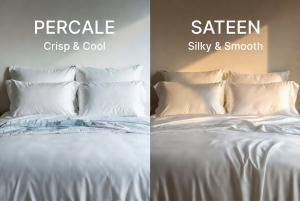
Percale cotton, particularly heavier heirloom-weight percale woven at 400 thread count or above, is the other strong contender. It has a crispness that reads as clean and timeless, and in white or ivory it brings the freshness of a country inn bed without effort. The key is to avoid the ultra-smooth sateen weaves, which are beautiful but carry a slightly modern sheen that works against the matte, earthy palette farmhouse style requires.
Color matters here: white is classic, warm white and ivory are better for farmhouse specifically, and pale grays, flax, and soft blush all work. Avoid anything too saturated or too cool-toned — the farmhouse palette lives in the warm, faded part of the spectrum.
The Middle Layers: Quilts, Blankets, and the Art of the Overlap
This is where farmhouse bedding earns its reputation. The layers.
A farmhouse bed is almost never just a sheet and a duvet. It is built up gradually, each piece contributing something different — texture, weight, visual softness, warmth — and the whole is considerably greater than the sum of its parts. Learning to layer is the skill that separates a bed that merely looks nice from one that stops you in the doorway.
The Quilt
The quilt is the cornerstone of farmhouse bedding. Not a comforter — comforters are puffier, more modern, and carry with them a certain suburban hotel energy that farmhouse style is specifically trying to avoid. A quilt is flatter, lighter, and infinitely more textured.
Traditional patchwork quilts, particularly those with simple geometric patterns like log cabin, nine-patch, or wedding ring designs, are the most authentic choice. If you can find a genuine vintage quilt at an estate sale or antique market, the visual effect is incomparable — nothing manufactured can quite capture the specific fading and softness of a quilt that has actually been used for decades. But high-quality reproductions do exist. Look for hand-stitched or machine-quilted cotton pieces with batting that is not too thick, and patterns that read as classic rather than kitschy.
For a more modern farmhouse approach, solid or near-solid quilts in white cotton matelassé — a woven fabric with a subtle raised pattern — are extraordinarily versatile. They read as clean and refined but are unmistakably farmhouse in their texture. A white matelassé quilt draped across the lower third of a bed, with linen sheets folded over it, is one of the simplest and most effective bedding arrangements in existence.
Coverlets and Woven Blankets
Between the sheets and the quilt, or sometimes in place of it, a coverlet or woven blanket provides another layer of texture. Waffle-weave cotton coverlets are particularly well-suited to farmhouse style — their grid texture reads as handmade, they are lightweight and breathable, and they come in the exact palette (ivory, gray, sage, soft blue) that the look requires.
Chunky-knit throws are another farmhouse staple, but they require a careful hand. A throw that is too perfect, too evenly knit, or too brightly colored loses the casually gathered quality that makes farmhouse layering work. Look for loosely knit throws in natural wool or cotton, in undyed cream or heathered gray, and use them at the foot of the bed or draped asymmetrically across one corner — never laid flat and squared.
The Top Layer: Duvets and Duvet Covers Done Right
The duvet — if you use one — should be luxurious enough to justify its existence in what is already a heavily layered situation. A good farmhouse duvet cover is not the primary visual element of the bed; it is more like a backdrop against which the other elements perform.
Stonewashed linen duvet covers in white, warm ivory, or soft gray are the farmhouse standard for good reason. The texture is present but not loud, the color is calm and receptive, and the slight wrinkle that comes with linen reads as deliberately casual rather than simply messy. If you are only going to invest in one linen piece for your bed, make it the duvet cover.
The button closure matters more than most people realize. Traditional bone buttons, wooden buttons, or fabric-covered buttons in matching linen all preserve the aesthetic; plastic snaps or zipper closures feel like a betrayal of everything the farmhouse bed stands for.
Ticking stripe duvet covers — narrow, evenly spaced stripes in navy, black, or charcoal on white or cream — bring a slightly more graphic energy to the bed. They reference the old grain sack and mattress ticking fabrics of actual farmhouses without being literal about it. Paired with solid linen shams and a simple white quilt at the foot, a ticking stripe duvet cover anchors the bed with a quiet confidence.
The Details: Pillows, Shams, and the Throw Pillow Question
Pillows are where farmhouse bedding either coheres or collapses into chaos.
The general structure for a well-made farmhouse bed, working from headboard to foot: sleeping pillows in plain linen cases, then Euro squares in shams that coordinate but do not match exactly, then one or two throw pillows for personality. That's it. The instinct to pile on more — more pillows, more patterns, more colors — is the instinct to resist.
Euro shams in linen or brushed cotton, with simple envelope or flanged edges, are the most versatile choice. They frame the bed without competing with anything else. In white or warm flax, they disappear beautifully into the overall palette. In a very soft stripe or subtle print — a fine grid, a barely-there botanical — they add just enough interest to justify their presence.
For throw pillows, one or two at most, farmhouse style welcomes a slightly more personal note. Vintage grain sack pillows — actual vintage grain sacks repurposed as pillow covers, with their faded stenciled lettering and coarsely woven linen — are hard to beat for authenticity. Failing that, hand-embroidered pillow covers, small-scale floral prints, or simple block letters in linen are all compatible with the look.
What does not belong: velvet throw pillows, heavily embellished decorative pillows, anything with a slogan or novelty print, shiny or synthetic fabrics. The farmhouse bed is not interested in showing off. It is interested in feeling good.
Color and Pattern: The Farmhouse Palette in Depth
The farmhouse color palette is often described as neutral, which is accurate but slightly misleading. These are not cold, abstract neutrals. They are warm, organic, and quietly varied — the colors of undyed linen, washed cotton, old wood, bleached stone, dried lavender.
White is the constant, but there are many whites. For farmhouse bedding, the whites that work are warm: cream-white, linen-white, off-white with a faint yellow or gray cast. Bright, blue-toned white — the color of commercial bleach and fluorescent lighting — is too clinical for this aesthetic. It fights with the warmth of natural materials and the organic quality of the palette.
Around the white, the farmhouse bedroom builds its color story in layers. Soft blue — particularly the kind that reads as slightly gray, like aged denim or summer sky just before dusk — is one of the most compatible companions. It appeared in historic farmhouse interiors through indigo-dyed quilts and stoneware crockery, and it still reads as essentially farmhouse even today.
Sage green is the other workhorse of the contemporary farmhouse palette. Not the bright botanical green of a greenhouse, but the dusty, slightly silvered green of dried herbs, lichen, and old painted furniture. In a pillow cover, a light throw, or a single duvet cover, sage green adds life to an otherwise all-neutral bed without disrupting its calm.
Pattern in farmhouse bedding functions through restraint. A ticking stripe and a floral and a check all on the same bed is too much. But a solid linen duvet with one ticking stripe sham, or a gingham pillow against plain white bedding, creates exactly the right amount of visual interest — enough to read as considered, not enough to be distracting.
Scale matters enormously with pattern. Small-scale checks, narrow stripes, and fine florals all feel appropriate. Large-scale patterns — oversized buffalo check, big block prints, wide stripes — tip the aesthetic toward something bolder and more graphic than traditional farmhouse sensibility calls for.
Styling the Farmhouse Bed: The Assembly
There is a method to the layering, and it is worth describing in sequence.
Start with the fitted sheet tucked smoothly. The top sheet — and yes, a top sheet belongs on a farmhouse bed, both for practicality and aesthetics — should be either left flat or folded back over the duvet or quilt by about twelve inches at the headboard end. This fold, showing the contrast of white sheet against whatever is beneath it, is one of the small things that makes a farmhouse bed look intentional.
The quilt, if using one, can be spread across the entire bed, folded in thirds across the lower half, or draped at an angle for a more casual effect. A quilt spread fully across the bed, then turned back at the top to reveal the sheets, creates a hotel-like tidiness that still reads as homey due to the texture.
The duvet, if separate from the quilt, typically goes on top and is turned back at the headboard end in the same way as the sheet. When using both a quilt and a duvet, the quilt usually sits on top of the duvet cover — used more as a decorative layer and light extra warmth than as primary bedding.
Sleeping pillows go to the back, in their cases, upright against the headboard or headboard pillows. Euro squares in shams come next, in front of them. Throw pillows come last, in front of everything. The whole arrangement should look like it took about four minutes to assemble, even if it didn't.
The throw goes at the foot, folded loosely rather than pressed. It can drape off one corner or sit in a soft diagonal across the lower third of the bed. It should look like someone put it down there on the way to make coffee and it just happened to land perfectly.
The Headboard and Surrounding Elements
Farmhouse bedding does not exist in isolation, and the headboard is the piece that either reinforces or undercuts the look.
An upholstered headboard in linen or cotton, in natural or white, is the most versatile choice for farmhouse style — soft, textured, and warm without being heavy. Slipcovered headboards, which allow the cover to be changed or washed, are particularly appropriate for a look that values practicality alongside beauty.
Wooden headboards in painted white, aged gray, or natural reclaimed wood tones are the alternative with more visual personality. A wide plank headboard in white-washed wood, or a simple shiplap panel mounted behind the bed, brings the architectural quality of farmhouse interiors directly into the bedroom.
Metal beds in matte black or antique bronze work well with the aesthetic when the line is simple — a classic bed frame, an iron canopy, a curved brass headboard. The key is simplicity. Ornate metal work, by contrast, pulls toward a different sensibility entirely.
Seasonal Adaptation: Keeping the Look Through the Year
One of the practical advantages of the farmhouse bedding approach is how naturally it adapts to seasonal change. The layering structure makes adding and removing warmth genuinely effortless.
In summer, the quilt alone as the main layer, over linen sheets with the duvet stored away, keeps the bed looking full without being oppressively warm. A simple cotton waffle coverlet in place of the duvet does similar work and reads as appropriately lighter for the season.
In winter, the full layering structure comes into its own — sheets, quilt, duvet cover, extra throw — and the bed becomes genuinely cozy rather than just aesthetically so. Adding heavier-weight linen or flannel-lined duvet covers for winter, switching back to cotton percale in summer, gives the room a seasonal rhythm that feels in keeping with the farmhouse philosophy of living in tune with the natural world.
Where to Source Farmhouse Bedding Worth Having
The market for farmhouse-style bedding has expanded dramatically, which means both more options and more noise to sort through.
For linen specifically, European mills — Belgian and French in particular — still produce the best quality, and several direct-to-consumer brands source from them at accessible price points. Stonewashed linen in particular rewards spending slightly more, as the quality difference between mid-range and premium is genuinely apparent in how the fabric feels and how well it holds up through years of washing.
For quilts, the vintage and antique market remains the richest source of pieces with genuine character. American vintage quilts from the mid-twentieth century and earlier turn up regularly at estate sales, through Etsy sellers who specialize in textile antiques, and at good antique fairs. They vary widely in condition and price, but even a quilt with minor wear has a beauty that no reproduction quite matches.
For everyday layering pieces — waffle coverlets, cotton blankets, basic shams — mid-range retailers with a serious commitment to natural materials serve the farmhouse aesthetic well, often at prices that make replacing worn pieces painless.
The investment principle for farmhouse bedding is simple: spend most on what touches your skin (sheets) and what provides the primary warmth (duvet insert), and be a little more flexible with decorative layers, where the character of the piece matters more than any single material specification.
A Final Word on the Philosophy
There is a particular kind of beauty that farmhouse bedding embodies — the beauty of things that are good at what they do and honest about what they are. A linen sheet is beautiful because it is genuinely comfortable and wears beautifully over time. A handmade quilt is beautiful because it carries the evidence of the time and care that made it. A worn cotton blanket is beautiful because it has been used, and use is not damage — it is a record of a life being lived.
This is a harder philosophy to sell than novelty or luxury or trend, which is perhaps why farmhouse bedding keeps surprising people when they actually experience it. It looks calm, and it is calm. It looks inviting, and it is inviting. It promises a good night's sleep wrapped in things that are quietly, entirely themselves.
That is not nothing. In fact, it might be everything a bedroom needs to be.